Payday Super Starts 1 July 2026
Payday Super Starts 1 July 2026
What Businesses Using Labour Hire Should Know
From 1 July 2026, Australia will introduce one of the most significant changes to superannuation administration in decades.
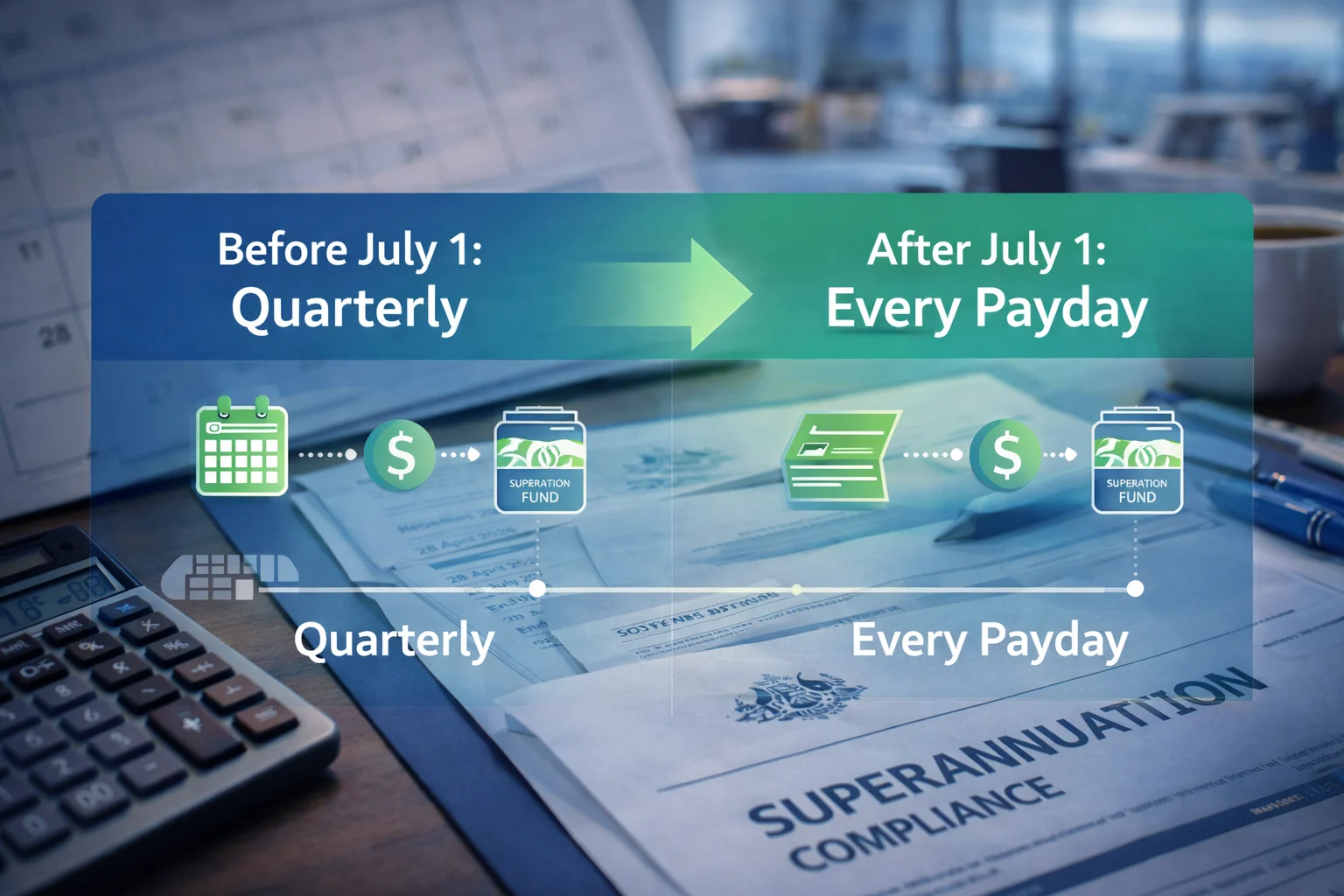
Under the new Payday Super framework, employers will be required to pay superannuation contributions at the same time as employee wages, rather than quarterly as occurs today.
For businesses that rely on labour hire providers, this change is particularly important. While the labour hire company is responsible for paying super for the workers they employ, the operational impact of any disruption can still affect the businesses those workers support.
With the July 2026 deadline approaching, now is a good time for organisations to understand what is changing and to ensure their workforce suppliers are prepared.
What Is Changing?
Currently, employers pay superannuation quarterly. Contributions are due 28 days after the end of each quarter.
From 1 July 2026, the process shifts significantly:
Current system (until 30 June 2026)
- Super paid quarterly
- Calculated on Ordinary Time Earnings (OTE)
- Contributions may be processed weeks or months after wages are paid
New system (from 1 July 2026)
- Super must be paid at the same time as wages
- Contributions must reach the super fund within seven days of payday
- Super will be calculated on a broader definition known as Qualifying Earnings
For organisations running weekly or fortnightly payrolls, this means moving from four super payments per year to potentially dozens.
For labour hire providers managing large casual workforces, the operational and financial changes can be substantial.
Why This Matters for Businesses Using Labour Hire
If your organisation uses labour hire workers, the super obligations technically sit with the labour hire employer, not the host business.
However, changes like Payday Super can still affect the reliability of workforce supply.
For example, labour hire providers must ensure:
- Their payroll systems are updated
- Super contributions can be processed quickly and accurately
- Payroll and finance processes can support more frequent payments
- Staff are trained on the new calculation rules
Where providers are well prepared, the transition should be smooth.
Where preparation is lacking, the change may place pressure on internal systems or processes.
For host businesses, the key takeaway is simple: ensure your workforce partners are aware of the changes and preparing accordingly.
The Calculation Change: Qualifying Earnings
Another important part of the reform is the move from Ordinary Time Earnings (OTE) to Qualifying Earnings (QE) when calculating super.
While the exact details depend on the final legislative framework, QE is expected to include a broader range of payments than the current OTE definition.
For employers and labour hire providers this means payroll systems must be able to:
- correctly classify earnings
- calculate super contributions under the new rules
- report payments accurately through Single Touch Payroll.
These are largely payroll and compliance processes, but they reinforce why preparation and system readiness matter.
The End of the Small Business Super Clearing House
Another change accompanying Payday Super is the closure of the ATO Small Business Super Clearing House (SBSCH).
The clearing house closed to new users in October 2025 and will cease operating on 30 June 2026.
Businesses that previously relied on that service will need to transition to:
- payroll-integrated super payment systems, or
- commercial clearing house providers.
Many payroll platforms are already adapting to support these changes.
What Businesses Should Do Now
For most businesses using labour hire, the key step is simply checking in with your provider.
Questions worth discussing include:
- Are payroll systems being updated for Payday Super?
- Are internal payroll teams trained on the new requirements?
- How will super payments be processed after July 2026?
- Has the transition away from SBSCH been planned?
These conversations are not about auditing providers — they are about understanding readiness ahead of the transition.
How United Recruiting Solutions Is Preparing
At United Recruiting Solutions, we have been reviewing the Payday Super reforms as part of our broader compliance and payroll processes.
Preparation has focused on areas such as:
- ensuring payroll systems support the updated super payment timing
- reviewing internal payroll workflows
- working with software providers on system readiness
- monitoring legislative guidance and implementation timelines
Like many employers across Australia, we are continuing to monitor regulatory updates and ensure our processes align with the new framework as it approaches.
For our clients, the goal is straightforward: maintain reliable workforce supply while adapting smoothly to regulatory change.
Looking Ahead
The move to Payday Super reflects a broader shift toward more transparent and timely superannuation payments for workers.
For most businesses, the change will primarily be handled behind the scenes by payroll systems and employers.
However, organisations that rely on labour hire or contingent workforces may benefit from taking a few minutes to confirm their providers are aware of the changes and planning accordingly.
With the reform commencing 1 July 2026, early preparation helps ensure the transition is smooth for workers, providers and host businesses alike.
About United Recruiting Solutions
United Recruiting Solutions is a labour hire and recruitment provider servicing organisations across manufacturing, logistics, construction and engineering sectors.
Based in Melbourne and operating nationally, URS works with businesses to supply reliable workforce solutions while maintaining strong compliance and employment practices.
To learn more about United Recruiting Solutions or discuss workforce requirements, contact our team today